
Conference paper
Augmenting the Workspace of Epigraphists. An interaction design study
An interaction design study on using natural user interfaces and the sensors in tablets and smartphones for common epigraphic workflows.
Abstract
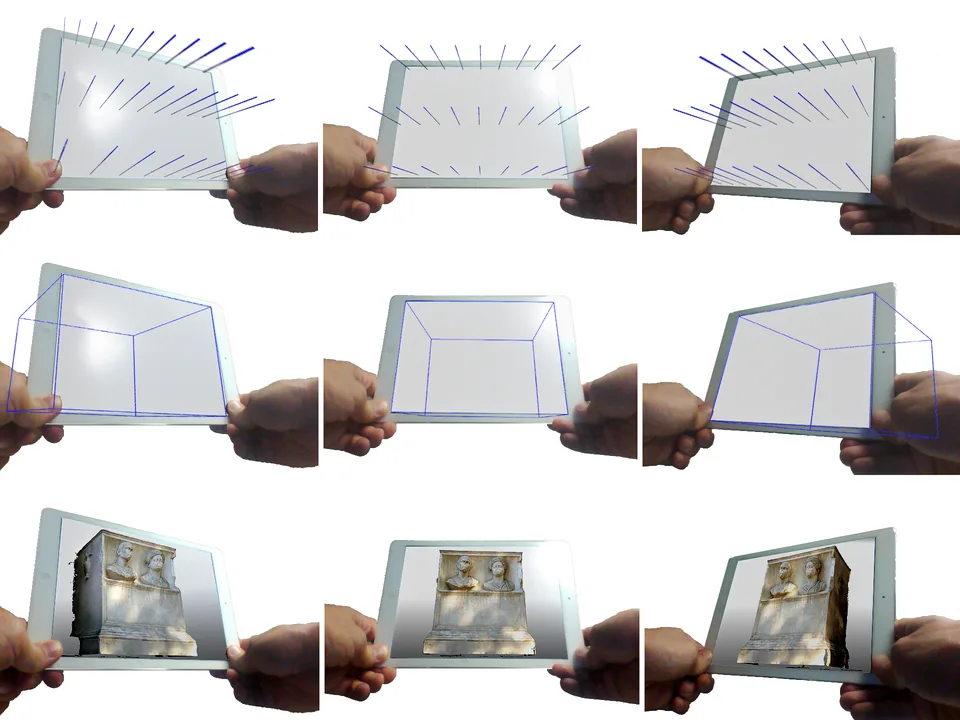
This paper presents the results of an interaction design study that focuses on the use of natural user interfaces for professionals in the fields of epigraphy and archaeology. This study proposes solutions for utilizing the sensors that can be found in popular handheld devices, such as tablets and smart phones, in order to naturally perform common tasks from the typical work-flow of epigraphists. The developed interface allows the users to naturally hold digitized inscriptions, interact with them in order to relight or manipulate them as if they were real physical objects, and interact with metadata or other multi-modal data, such as text and images.
Cite this publication
Citation
Barmpoutis, Angelos; Bozia, Eleni (2017). Augmenting the Workspace of Epigraphists. An interaction design study. Proceedings of the EAGLE 2016 International Conference, Digital and Traditional Epigraphy in Context, 36, pp. 209–220. Sapienza Università Editrice. https://doi.org/10.13133/978-88-9377-021-7
BibTeX
@inproceedings{barmpoutis2016augmenting,
  author = {Barmpoutis, Angelos and Bozia, Eleni},
  title = {Augmenting the Workspace of Epigraphists. An interaction design study},
  booktitle = {Proceedings of the EAGLE 2016 International Conference, Digital and Traditional Epigraphy in Context},
  year = {2017},
  volume = {36},
  pages = {209--220},
  publisher = {Sapienza Università Editrice},
  isbn = {978-88-9377-021-7},
  doi = {10.13133/978-88-9377-021-7},
  url = {https://doi.org/10.13133/978-88-9377-021-7}
}